
Dead in Antares Review (2026)
The Definitive Verdict
Ishtar Games’ boldest survival RPG yet — but is it a true evolution or just a sci-fi reskin? We break it all down.

Dead in Antares (2026) — Key Art. Source: Steam / Nacon
“Sometimes, we long for the sweet escape. Death, at last” — Dead in Antares is available NOW! store.steampowered.com/app/2511800
— Ishtar Games (@ishtar_games) February 19, 2026
🚀 What Is Dead in Antares?
Dead in Antares is the third standalone game in Ishtar Games’ beloved “Dead in” series — following Dead in Bermuda (2015) and Dead in Vinland (2018). This time, the setting leaves Earth history behind entirely and jumps 550 light-years into space.
You lead Captain Amelia Rosenhart and her nine crewmates, the team behind the mission of the Ixion. Their job? Find resources to save a dying Earth. What they get instead is a wormhole, a crash landing, and survival on an alien world full of dangerous fauna, ancient mysteries, and two warring alien factions.
🌿 Key framing: Think of Dead in Antares as a cross between I Was a Teenage Exocolonist and Fire Emblem — it has the ethical weight of the former and the relationship-driven strategy of the latter, wrapped inside a resource management loop that never lets you relax.
The “Dead in” Series at a Glance
| Game | Setting | Release | Steam Rating |
|---|---|---|---|
| Dead in Bermuda | Tropical island (modern) | 2015 | Mostly Positive |
| Dead in Vinland | Viking Age island | 2018 | Very Positive |
| Dead in Antares | Alien planet (sci-fi) | Feb 19, 2026 | Very Positive (80%+) |
🎮 Gameplay: What You Actually Do All Day
Here’s the honest truth — Dead in Antares is a micromanagement game at heart. If that sounds exhausting, don’t worry. It is also one of the most satisfying management loops you can find in indie gaming right now.
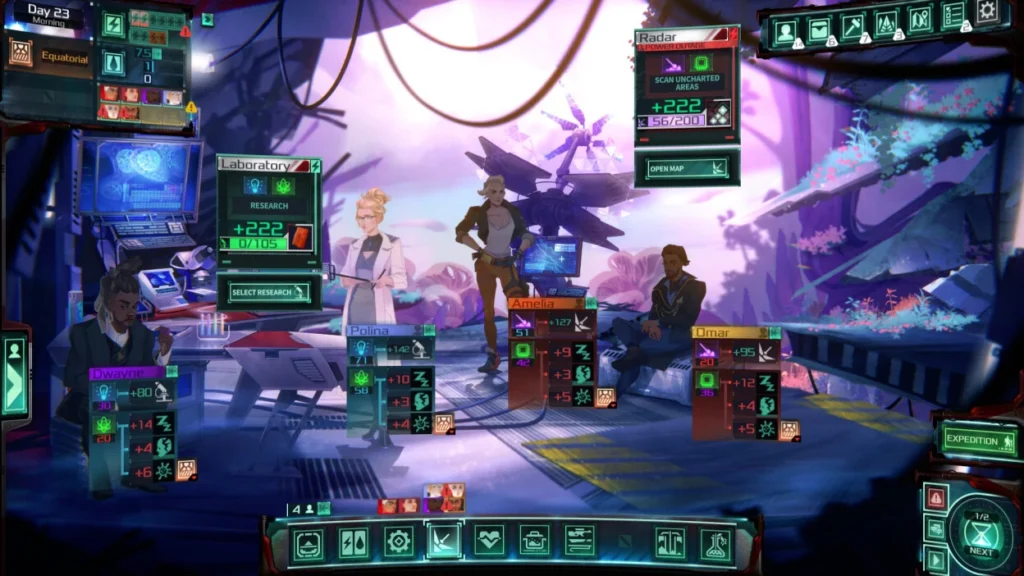
Each in-game day is divided into clear phases. You assign tasks, send expeditions, monitor five character health bars, research technology, and make story choices that can alter your crew’s fate. Miss a few water rations? Someone gets sick. Push your best explorer too hard? They collapse from fatigue mid-mission.
The 5 Status Bars You Must Never Ignore
- Fatigue — Overwork anyone and their performance tanks fast.
- Hunger — Food is scarce early. Murky water saves resources but risks illness.
- Sickness — Spreads. William the medic becomes critical fast.
- Injury — Combat wounds linger. Healing requires time and materials.
- Stress — The sneakiest killer. Unresolved crew conflict spirals into morale collapse.
💡 Design insight: Any single bar reaching 100 kills that character — and a character death ends your run entirely. This one rule turns every mundane choice into a life-or-death decision. Giving someone dirty water suddenly feels like playing with fire.
Exploration: Tile-Based and Purposeful

The tile-based expedition system replaces the older abstract camp model. Source: Steam
Dead in Antares overhauled how exploration works compared to previous entries. You send teams of up to three characters across a branching tile map. Every tile represents a real choice — distance adds fatigue, weather changes encounter rates, and skill checks are now visible before you commit.
- Discover rare alien resources and technology.
- Trigger story events that shift faction relationships.
- Encounter hostile creatures — sneak past or ambush them.
- Find scattered pieces of your crashed ship, the Ixion.
Combat: Turn-Based with a New Twist
Combat is a secondary pillar — it supports the survival loop rather than dominating it. That said, it has been significantly upgraded from Dead in Vinland. Battles now reward positioning, synergy, and timing rather than raw damage output.
The headline new mechanic is the Power Surge — a character-specific ultimate ability. William’s Power Surge, for example, is widely considered overpowered by the community (in the best way). With 60+ abilities across 10 characters, team composition becomes a genuine strategic layer.
📖 Story & Characters: The Real Reason to Play
If there is one thing Dead in Antares does better than almost any survival game on Steam right now, it is making you care about your crew. These are not stat blocks with names. They are people — with histories, biases, personal traumas, and strong opinions about each other.
Meet the Crew of the Ixion
| Character | Role | Key Trait |
|---|---|---|
| Captain Amelia Rosenhart | Commander | Tough charm; struggles with command weight |
| William Eriksson | Field Medic | Sharp instincts; carries a guilty conscience |
| Liu Jian | Engineer | Emotionally distant; treats people like machines |
| Polina Shevchenko | Astrophysicist | Brilliant; torn between science and family |
| Noemi | Biologist | Biology genius; poor in combat and stealth |
| + 5 more | Various | Unlocked through gameplay |
The relationship system drives the whole emotional engine. Who you pair together on tasks, who rests near whom, who fights side by side — all of it generates unique dialogue interactions. Over 135 relationship-specific conversations exist in the game. Strong bonds boost efficiency. Unresolved rivalries spike stress. Breakdowns can sabotage critical missions.
🌍 Ethical weight: The story asks a hard question — how much right does a dying humanity have to exploit another world’s resources? The answer depends on the choices you make. There are multiple endings, and none of them are easy.
🎨 Visuals & Audio: A Beautiful, Weird World

Ishtar Games’ signature hand-drawn 2D art style — bioluminescent jungles and crystalline forests. Source: Steam
Antares Prime is the most visually striking setting in the series. The hand-drawn 2D art style covers three distinct biome types:
- 🌿 Bioluminescent jungles — alien plants that glow in impossible colors.
- 🌋 Volcanic deserts — scorching wastelands hiding ancient ruins.
- 🔮 Crystal forests — eerie, beautiful, and full of secrets.
Character portraits are visual novel-quality — each one instantly communicates personality and emotional state. The earthy Norse tones of Dead in Vinland give way to vibrant, almost unsettling color saturation here. Some players find it overwhelming at first. It grows on you fast.
The music is a genuine standout. Lyrical, introspective tracks play during camp scenes, building an atmosphere that several reviewers have compared to the quiet, meditative moments in Death Stranding. Combat audio is functional but less refined — the one area where the sound design could use more punch.
One notable gap: There is no voice acting. For a game this narrative-heavy, that absence is felt. It does not break the experience, but it remains the most common complaint among Steam reviewers.
⚔️ Dead in Antares vs. Dead in Vinland
This is the question every fan is asking. Here is the honest side-by-side:
| Feature | Dead in Vinland | Dead in Antares |
|---|---|---|
| Setting | Viking Age island | Alien planet (sci-fi) |
| Characters | Family unit (4 main) | 10 crew specialists |
| Exploration | Abstract, event-based | Tile-based, skill-visible |
| Combat | Turn-based basics | 60+ abilities + Power Surge |
| RNG | High; frequent frustration | Reduced; more transparent |
| Relationship System | Limited | 135+ unique dialogues |
| Replayability | High (random events) | Lower (more linear story) |
| Difficulty Curve | Brutal from day 1 | Structured / more gradual |
| Voice Acting | None | None |
| Story Depth | Good | Excellent |
The verdict? Antares is the better, more polished game. Vinland has a slight edge in raw replayability thanks to its higher RNG variance. But Antares wins on almost every other dimension — deeper relationships, richer story, more transparent mechanics, and a more ambitious world.
✅ Pros & Cons
✔ What Works
- Deep, emotionally engaging character system
- 135+ unique relationship dialogues — rare in this genre
- Transparent skill checks reduce frustration vs. Vinland
- Stunning hand-drawn alien world across 3 biomes
- Power Surge combat mechanic adds real tactical depth
- Multiple endings tied to genuine moral choices
- Introspective, atmospheric soundtrack
- Strong story pacing that rewards patient players
✘ What Doesn’t
- No voice acting for a highly narrative game
- Restrictive opening — limited choices in first few days
- Lower replayability once the story is finished
- Combat can feel drawn out in early encounters
- No difficulty slider for players wanting more control
- Some character archetypes feel familiar/predictable
💡 7 Beginner Tips to Survive Your First Week
Your first in-game week is the hardest. The game gives you a lot to track at once. Use these tips to avoid the most common early mistakes:
- Prioritize water first, always. Dehydration escalates sickness. Set up water collection before anything else.
- Never max out one character’s workload. Rotate tasks to keep fatigue below 60 on everyone.
- Match crew to their specialties. Noemi is a biology genius — don’t send her stealth missions. Liu is your engineer — keep them at the workstations.
- Build relationships intentionally. Pair the same two characters on tasks repeatedly. Relationship bonuses improve task efficiency and unlock key story dialogue.
- Use William’s Power Surge early in fights. It is disproportionately powerful in early combat — exploit it while you can.
- Trade with Antarians for Knowledge. You need ~2,000 extra Knowledge beyond map exploration to max out camp upgrades. Trade slime or orange powder with Ooweigh for 100 knowledge per visit (5 trades max).
- Don’t ignore stress. A depressed or overworked crew member will refuse critical tasks at the worst moment. Keep morale up through rest, paired tasks, and story choices.
🎯 Who Is Dead in Antares For?
Not every game is for everyone. Here is a quick check to help you decide:
- ✅ Play it if you love games like Frostpunk, RimWorld, or I Was a Teenage Exocolonist — management + story is your sweet spot.
- ✅ Play it if you finished Dead in Vinland and want more of everything it did well.
- ✅ Play it if you enjoy visual-novel-style storytelling with real mechanical weight behind your choices.
- ⚠️ Skip it (for now) if you need high replayability — the linear story means a second playthrough feels less fresh.
- ⚠️ Skip it if you want fast-paced action — this is a slow, deliberate, thinker’s game.
- ⚠️ Skip it if constant micromanagement stresses you out more than it satisfies you.
❓ Frequently Asked Questions
Yes. With an 80%+ “Very Positive” rating on Steam and meaningful improvements over its predecessors, Dead in Antares is a strong buy for fans of survival management and story-driven RPGs. The $25–30 price point reflects fair value for a 20–30 hour, story-rich experience.
No. Dead in Antares is fully standalone with its own cast and story. If you’ve played Vinland, you’ll appreciate the improvements more clearly — but newcomers can dive straight in without missing anything essential.
A single playthrough runs roughly 20–30 hours depending on how much dialogue you read. The game is story-linear, meaning a second full run offers limited new content currently — though the developer has indicated future DLC updates.
As of March 2026, Dead in Antares is PC-only via Steam. No console or Game Pass version has been officially confirmed. Check the Steam store page for the latest platform news.
Without spoiling details: the main ending variables involve whether you stay or leave Antares Prime, and what you choose to do with a key resource discovered on the planet. The “best” ending for the native Antarians is widely considered to be the “Leave + Leave behind the MacGuffin” path — though it is the most morally bittersweet for your crew.
It is more structured but arguably less brutally punishing in the early game. Vinland’s high RNG could devastate runs randomly. Antares shows you the skill checks beforehand, making failure feel more understandable and strategic rather than arbitrary.
🔗 Looking for more game guides and word puzzles? Try our daily Wordle challenge or explore our full games archive for strategy guides, tips, and puzzle breakdowns updated daily.
📚 References & Sources
- Dead in Antares — Official Steam Page, Ishtar Games / Nacon (2026)
- Dead in Antares — Steam Community Reviews & Discussions (March 2026)
- Dead in Antares — Metacritic Score Aggregation (2026)
- Checkpoint Gaming — “Dead in Antares Review: Survive in Alien Paradise” (March 2026)
- Gamer Social Club — Dead in Antares Review (February 2026)
- GamesCreed — Dead in Antares Review (February 2026)
- Game Critix — Dead in Antares Review (2026)
- Digital Chumps — Dead in Antares Review, PC (2026)
- Turn Based Lovers — Everything We Know About Dead in Antares (2025)
- Dead in Antares Tips & Tricks Guide — Steam Community Discussion
- DLCompare — “Dead in Antares Revives Old-School RPG Survival” (2026)